
How to keep your brand voice when AI writes your social posts
Build an AI brand-voice brief with writing samples, clear rules, before-and-after examples, and a review rubric. Includes a free reusable voice template.

The short answer
To preserve your brand voice in AI-written social posts, provide representative writing samples, describe observable language rules, and separate brand facts from stylistic preferences. Give each draft a specific audience and purpose, then review its claims and wording. Save corrected examples so future briefs show what your voice looks like in practice.
What to take away
- Examples and concrete rules are more useful than adjectives such as friendly or bold.
- Brand voice can change the wording of a claim, but not the facts behind it.
- Review voice through repeatable criteria instead of relying only on a feeling.
Why AI social posts often sound generic
A brief that says write an engaging post about our new feature leaves the writer with several unanswered questions. Who needs it? What changed? What can the product actually do? What would the brand never say? Without those details, a fluent draft can still sound interchangeable with any other company.
Adding friendly, professional, and authentic does not resolve much. Two brands can share those adjectives and write completely different sentences. One uses short, plain explanations. Another tells long personal stories. A third teaches through technical examples. A useful voice brief describes those observable choices.
Start by separating three inputs: what is true about the business, what the audience needs from this post, and how the brand expresses itself. When those inputs are mixed together, a stylistic request such as sound more confident can accidentally turn a tentative result into a guarantee.
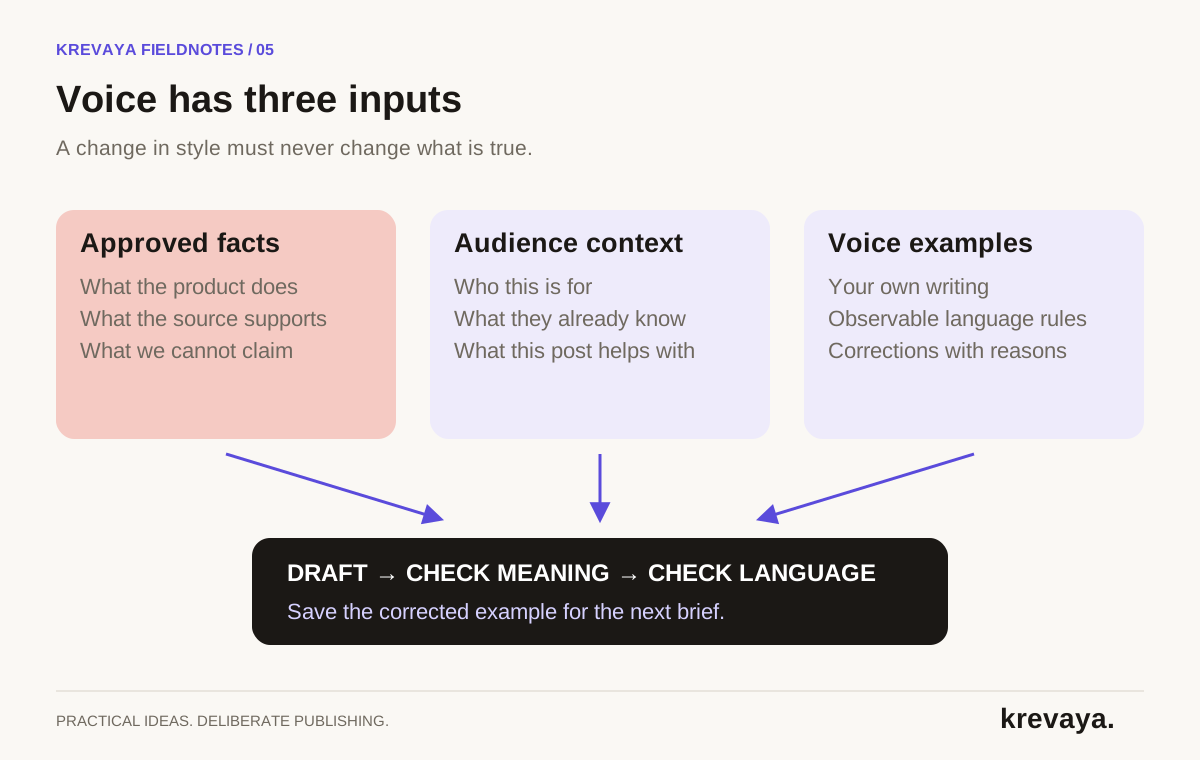
Build a small library of writing that sounds like you
Choose a manageable set of your own approved writing. Five to ten varied examples can be a useful starting exercise, but there is no magic sample count. Include an explanation, a product announcement, an opinion, an answer to a question, and a call to action if those formats are part of your real work.
Quality and representativeness matter more than length. A heavily edited campaign from years ago may describe a voice you no longer use. A recent answer written directly by the founder may show the current rhythm much better. Remove confidential information and anything you lack permission to reuse.
- Label the job. Explain whether the sample teaches, announces, reassures, or invites a response.
- Explain what works. Note the concrete opening, short paragraphs, restrained claim, or specific example you want to preserve.
- Include a rejected version. A before-and-after pair makes a boundary more visible than a long list of style adjectives.
- Keep the source date. Retire examples that describe old products, offers, or language you no longer want to use.
Do not build your voice by imitating a competitor's distinctive wording. Study your own decisions: what you explain carefully, what you assume the reader knows, and how you invite a next step. Those choices make the writing recognizable.
Turn vague brand adjectives into observable writing rules
| Vague instruction | Useful rule | What to look for |
|---|---|---|
| Be friendly | Address the reader directly and explain the next step plainly | Does the reader know what to do? |
| Be confident | State supported facts directly; preserve uncertainty where it exists | Has any caveat disappeared? |
| Be practical | Include a concrete example or an action the reader can take | Could someone use this advice today? |
| Be concise | Give the post one takeaway and remove repeated setup | Does each paragraph add something? |
| Be original | Use an observation from our work or an explicitly hypothetical example | Is the detail real and attributable? |
Add language boundaries that matter to your business. You might avoid inflated superlatives, forced jokes, jargon, or a claim that every reader shares the same problem. Be selective: a hundred prohibitions can bury the few rules that actually distinguish your voice.
A reusable AI brand-voice brief
Brand and audience:
What this audience already knows:
What we help them do:

Approved facts for this draft:
Sources and dates:
Claims we cannot make:

Voice rules:
- Lead with the concrete point.
- Use plain verbs and specific examples.
- Keep one main takeaway per post.
- Preserve uncertainty and product limitations.

Preferred vocabulary:
Phrases to avoid:
How we use humor, emoji, and punctuation:
How direct our call to action should be:

Approved writing examples with notes:
Rejected example and corrected version:

Task, platform, and format:
Desired reader action:
Details that need human confirmation:
Replace the sample voice rules with your own. The template is a starting structure, not a universal writing style. A technical founder may need precise terminology; a local bakery may need warmer sensory detail. Both can be specific and accurate.
Before and after: the same message with a clearer voice
Suppose the approved fact is that generated drafts wait in a review queue by default. The product lets users explicitly enable auto-publish per pipeline. The post's job is to explain that control, not promise audience growth.
Unlock the future of effortless social media with our game-changing AI platform. Create amazing content, skyrocket engagement, and take your brand to the next level while our intelligent system does everything for you.
The draft can be automatic. Your yes should be deliberate.

Krevaya puts AI-generated posts in a review queue by default. Read the caption, check the visual, and approve the version you want your audience to see.

Auto-publish is an option you turn on for a pipeline when you are ready.

See how review-first publishing works.
The revision names the actual behavior, explains the user's action, and includes the exception. It removes unsupported engagement claims. Its voice comes from clear choices about emphasis and wording rather than an extra layer of personality pasted onto a vague message.
For another brand, the final wording could differ. The stable requirement is that a voice change must not introduce experience, results, or capabilities the source does not support.
Use a simple rubric to review AI-written content
A reviewer needs more than does this sound right? Use the same checks on every draft so feedback can improve the next brief. Treat factual accuracy as a gate: a draft with invented facts does not pass because its tone is excellent.
| Check | Pass condition | Useful feedback |
|---|---|---|
| Factual accuracy | Every specific claim has support and retains its limits | The source says drafts, not automatically published posts |
| Audience relevance | The opening names a problem this reader recognizes | Explain the review step before naming the feature |
| Specificity | The post contains a concrete behavior, example, or action | Replace save time with the task that becomes easier |
| Language fit | Vocabulary and rhythm match the approved examples | Use a shorter opening and remove the superlative |
| Next step | The action is relevant, available, and proportionate | Link to the feature explanation rather than an unavailable signup |
Record the original line, the corrected line, and the reason. This is more actionable than a rejection labeled generic. After several batches, look for repeated edits. If the same correction keeps appearing, put it in the next brief and include a clear example.
Keep a consistent voice while changing tone and format
Voice is the recognizable pattern in your writing. Tone responds to the situation. A product update can be upbeat; a correction should be direct and accountable. Applying the same playful tone to every situation can make a brand sound less human, even if the vocabulary is consistent.
Platform adaptation also changes structure. A LinkedIn explanation may develop an argument over several paragraphs. A carousel may distribute the same idea across short, readable slides. A Threads or Bluesky post may ask a focused question. Preserve your standards for evidence, specificity, and respectful language while adjusting the format.
The repurposing guide shows several versions of one source. Use it to test whether your voice survives a change in structure without becoming the exact same caption everywhere.
How to apply this in Krevaya
Krevaya's AI Writing & Ideas supports a voice library and personas built from your writing. Drafts use that voice context, and the review queue lets you edit, approve, or reject before publishing by default. Keep the source material and the brief accurate so the system has something useful to work with.
Start with a small batch. Compare each draft with your approved examples, correct the specifics, and record recurring issues. Use the approval workflow to make that process repeatable. Increase automation only when the actual drafts justify the change.
Frequently asked questions
How do I make AI sound like my brand?
Give it representative examples of your own writing, annotate what makes them work, and define concrete rules for vocabulary, structure, and claims. Add a specific audience and task for each draft. Review the result and save corrected examples for future briefs.
What is the difference between brand voice and tone?
Brand voice is the recognizable pattern in how a business communicates. Tone changes with the situation and audience need. You can keep clear, practical language while using a more celebratory tone for a launch and a more direct tone for a correction.
How many writing samples do I need?
There is no universal required number. A small, varied set of approved examples is a useful starting point; this guide suggests five to ten as an exercise. Choose samples that represent your current voice and the formats you actually publish, then refine based on the drafts.
Can AI brand-voice tools replace editorial review?
They can help produce more consistent first drafts, but voice matching does not establish factual accuracy. A reviewer still needs to check claims, dates, product behavior, examples, and the final platform version. A familiar tone can make an incorrect statement sound especially convincing.
Sources & editorial details
Product and source pages checked September 20, 2026. Practical templates and worked examples are editorial guidance, not measured customer results.
Created with AI assistance and published by Krevaya AI. Send corrections to support@krevaya.com.